My leadership style is patterned to the “Major Payne approach” to ensure fairness and inclusivity.
Everyone is treated as turds until they earn enough respect to become maggots.
My leadership style is patterned to the “Major Payne approach” to ensure fairness and inclusivity.
Everyone is treated as turds until they earn enough respect to become maggots.
VS Code is my current editor of choice in the workplace as it is already pre-approved by the client and I dont need to jump through IT exception hoops to get PsPad allowed to be used. Its a bit bloated for my taste but it is starting to grow on me as I get used to the keybindings.
One thing that I am having problems is tracking which tab I am currently using. I normally have a dozen files open at any given time, and that number increases when I do file-by-file comparison within the VS Code editor. A quick search and the flow and configuration snippet allows me to change the color of the active file tab to the color of my choice.
"workbench.colorCustomizations": {
"tab.activeBackground": "#00AA00" #for green
}
Save and it automatically gets applied!

Returning to our NCR house after the holiday break yielded a small bounty from our small urban garden: a chili pods, tomatoes, eggplants and a fistful of okra:
The young okra pods were added to our seafood sinigang but a few were already too mature and very fibrous. I found some links in the web for air-frying mature okra and converting them to chip snacks. The premise is that the slimy interior will steam and allow the okra to become crispy. Below are the procedure and notes of this snack experiment.
Procedure
Verdict
The resulting chips were still fibrous as hell! Next time just cut up the mature okra pods and add them to the compost. 🙁
I am biased but ever since living in Metro Manila I never bought a single longganisa from the public market or grocery chains to be cooked at home. It has always been always the Cabanatuan longganisa (or “langgonisa” as it is called in most areas in Nueva Ecija) or bust in our household. There is already a few posts on how to cook it so here is just the quick rundown of what to do and what to avoid with this recado sausage. 🙂
Caveat: We now cook the longganisa in the air fryer. I just put a parchment paper under it for easy cleanup and oil extraction since we have those circular basket type. I still put in water at the start. 15 minutes at 160 degrees centigrade, flip and then 7-8 minutes more at 170 degrees. Another benefit of this cooking route is that the logganisa can go straight from the freezer to the airfryer basket, just ensure there is a single layer of sausage so they all get boiled first.
Context: Saving this emailed message I sent to one of my previous project teams. That project engagement (including the client and other providers) have a penchant for using NNTO, EOM, PFB and PFA in email conversations.
====
Subject: [Did you know that…] NNTO and EOM are only intended for emails that does not need to be opened?
NNTO is the abbreviation for “No Need To Open” and EOM stands for “End of Message”.
These are employed in subject headers to save the recipient time and the hassle of downloading the message and opening it up. The intent is that the recipient will be able to grasp the whole message by only reading the subject line.
With the same regard, if you respond to an email that initially had the NNTO and EOM in the subject line by writing in the email body then it is common netiquette to remove the NNTO or EOM from the subject of your response email, otherwise the recipient has less of an obligation to even open up your response to read your message.
Email netiquette also calls for limiting the use of abbreviations in the body of your email messages. Those are useful for limited input mediums like SMS, or limited devices like a GPRS-only handset but does not add a value to email communication. Contrary to popular belief in this project, PFB and PFA are not publicly used initialsms. Spare your recipients the additional hassle and type the whole phrase. Your communication karma points will get an upgrade if you do this.
“There is no need for perfection, but there is always room for improvement.” – Unknown
====
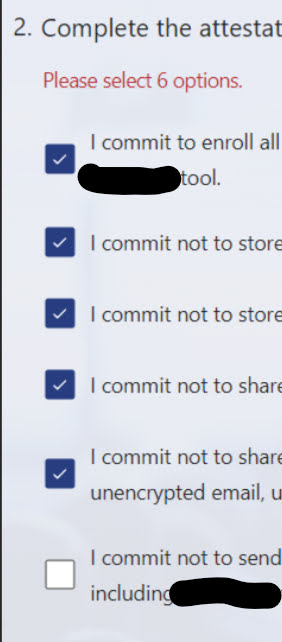
Lately I am seeing attestation forms in the projects I am working in wherein the contents are split across multiple checkboxes followed by a submit button. The beef I have is that the submit button will only be valid/enabled if all checkboxes are set to checked/true.
The problem with this approach is that it gives the wrong perception that you can say I dont agree to one or more of the provided options and you can still proceed. I assume the intent was to increase the possibility that the reader goes through each line but this is still bad form. The assumed intent does not guarantee that readers actually read the lines. All this does is increase the frustration of doing 5 more unnecessary clicks to the form.
If it was up to me, I will just list down the lines and then just put a checkbox at the bottom that states that the reader confirms to reading all the lines and agrees to follow them. It bears the same weight and legality, with 5 lesser clicks.
As of writing, I am working on a very controlled client environment (i.e. Citrix session) where the home drive is in a network share, and the machine session has a locked policy of only allowing signed poweshell scripts to execute.
I have my scripts in the Powershell folder which then gets this error because they are not digitally signed.
A solution presented is to run a new powershell session with the execution policy for the current user set to Bypass. Normally this needs to be done as an admin but it should be doable using the normal user. I wanted this to be part of my VS Code setup and this is how I configured it:
"args": [ "-noexit", "-ExecutionPolicy", "Bypass", "-file", "H:\\PowerShell\\functions.ps1" ]


I want to go shopping for some retail therapy
I want to go to the stores that sell diplomacy, patience and common sense. 🥰
I am feeling generous so I want to buy a lot to give away…….
straight down their throats. 😈
This is part of the “Posts from the Graveyard” which are emails I have sent to my then team or project. I am reposting them here for future reference before I finally delete them from my inbox.
The email was originally sent on August 1, 2014.
Team,
I am not sure if you have come across these little idioms and quotations but these should be apt for what we do:
The gist is please understand what we are doing. Do not be complacent in submitting something because it will pass mechanical validation; it should pass the validation of another sentient being like yourself who actually know what is the purpose of the item being validated. Aim to craft and submit something because it is good enough that you wont be embarrassed to say “I created that stuff, marvel at how good it is. That is the <insert-your-name> mark of craftsmanship.” It was mentioned yesterday to complete forms by providing information that is actually useful. The challenge is applying that mentality to every little bit of thing that goes out of your plate. Will you be amenable to buying something that is sub-par with the amount that you are paying? Of course you want something that is of equal or greater value. It should be the same way when we are the ones handling the production side of the equation.
If something is not correct, don’t contribute in perpetuating it. Aim to make things better. You can polish a turd till it shines, but it is still a turd.
ciao!
I was working on my trusty and crusty (15 year old!) desktop Pyg which just got a recent Manjaro reinstall, when suddenly the LVM partitions disappeared. The only clue I had is that the 3 directories that I use to access the logical volumes started throwing Input/Output error. I rebooted and it went straight to the recovery console (which is not a good place to be). I tried manually mounting the LVM partitions and it gave this error:
This was a bit of a shock and no reboot or safe mode can restore the directories. I put it off for the night and took it up again today. I was thinking maybe it was a recent Manjaro system in-place upgrade so I tried booting to the latest Ubuntu livecd (using Ventoy, which is very good for creating a multi-system bootable drive) hoping it will show up my lost LVM partitions.
I booted up to the Ubuntu live desktop and I didnt see any LVM mapper entries either. I see the same 800++GB unallocated space at the tail end of the SSD. I launched a filesystem check which didn’t reveal anything and started searching on how to manually input the the LVM sectors in the GPT metadata.
I searched my Google keep for Pyg’s partition layout and then it hit me that all I am seeing is the SSD. There is a WD Blue mechanical drive in this machine before I upgraded to SSD and I used that for storage for files before they are backed up to either DVD or BlueRay. I checked the BIOS of the desktop and it confimred that the HDD is not showing up. Opening up Pyg seems to be my next weekend project.
Curiously enough, I am not feeling as much worry on losing the files as I remember the first time that my WD Green drive malfunctioned. Maybe those files in the LVM partitions (warehouse [files], limbo [multimedia] and arena [game files[) are really not worth that much in the grand scheme of things. If I can still recover them then thats fine but if not then…